

Understanding The Fallen Angel
A beautiful masterpiece you've likely seen almost everywhere

Hello and welcome back to Ramblings! We’re still going on art history, and today, let us understand The Fallen Angel by Alexandre Cabanel together!
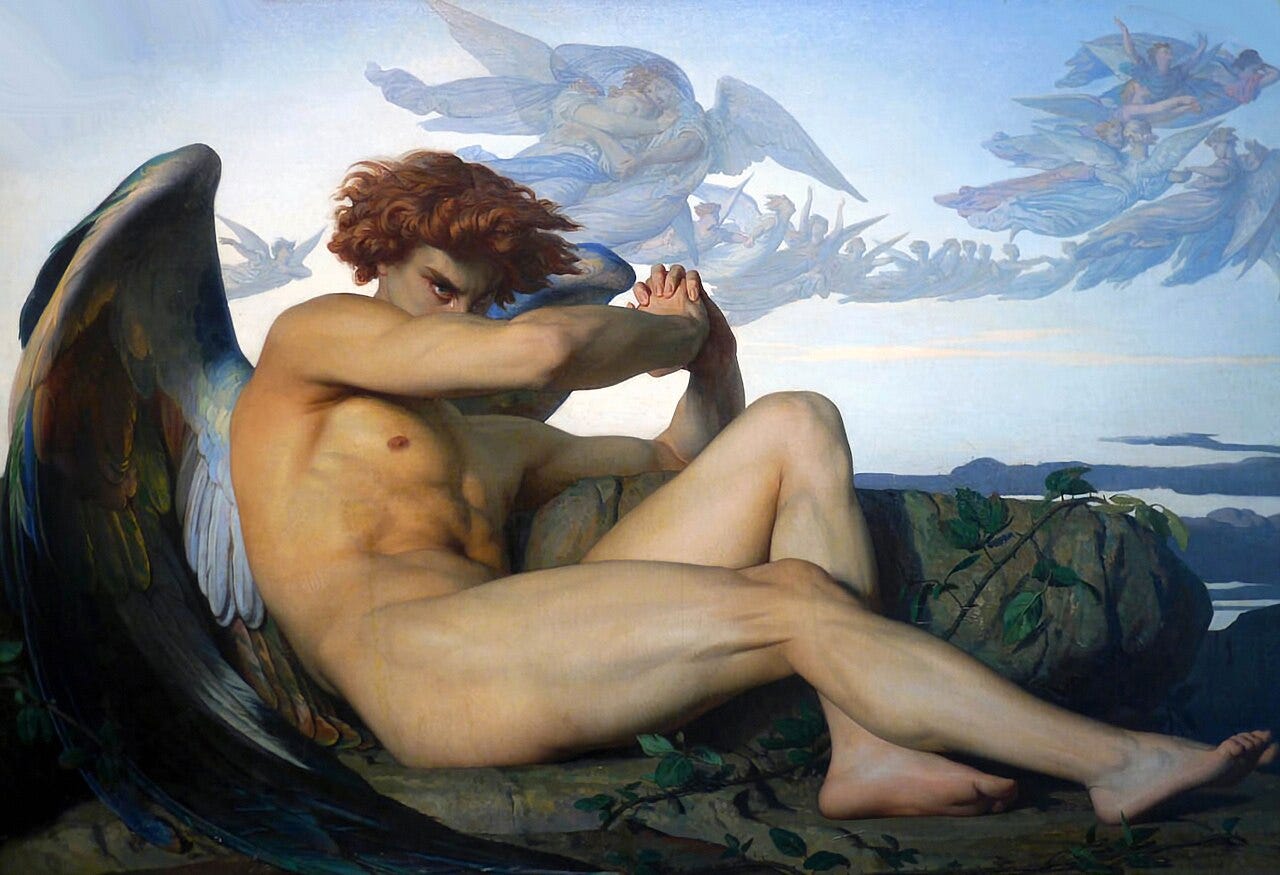
The Fallen Angel is an oil on canvas painting made by French artist Alexandre Cabanel in 1847.
This was the depiction of the Devil’s fall from heaven, though this was a very daring one — nobody had painted Lucifer like this before. Nobody dared to, actually.
Here, the Devil is not portrayed as monstrous or demonic but rather shown as a figure of divine beauty. His body sculpted as a reminiscent of a Greek God lies on a rocky ground with his muscles tense and his hands clenched as if he’s trying to contain intense emotions.
His body language is well done, but what really captivates us here are his eyes. Cabanel forces us to hold Lucifer’s stare, to confront his eyes filled with hatred, resentment and something deeper than a downfall.
Above him, the sky still gleams with angels celebrating God’s glory, and Lucifer is alone. But has he truly accepted his fate? Why do his eyes burn with such intensity? Is it because of the pain of being defeated, or the fury of plotting revenge? Is he planning to rise again, or drowning in despair?
Alexandre Cabanel painted this masterpiece when he was only 24 years old. During his stay in Rome, Cabanel created his first study for this painting which had similar elements to the final work.
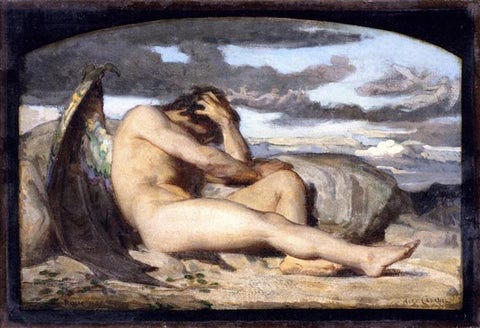
In this version, we do see similarities between the final piece. The rocky ground, Lucifer’s posture, and the sky with triumphant angels is the same. The noticeable change, however, is that in this Lucifer seems openly defeated. He clutches his bowed down head and his gaze is completely lost. He seems to accept the absolute sense of defeat. However, in the version we know of now, Lucifer holds his gaze with us, the viewer, directly. His emotions are at an indecipherable severity, which we can figure out by simply his eyes. We can see anger, betrayal, resentment, humiliation, and so much more mixed in an intensity he’s struggling to handle. Another change are the thorny branches at Lucifer’s feet, which signify his wounded pride, jealousy and desire for revenge. Another thing to notice here are his wings — angels are usually depicted with pure white wings to signify divinity, and here, we catch a glimpse of Lucifer’s wings metamorphosizing from white to a muddy gray color. The structure of the wings also looks very heavy instead of something natural which we see in the case of most depictions of angels, they look broken and exhausted. His ability to soar through the wind has been taken away from him, forcing him to retreat to the earthly dirt. This painting is paused in time, it isn’t showing Lucifer as an angel, neither is it showing him as the Devil with the bat-like scaly wings.
Cabanel faced a lot of criticism and controversy because of his painting. In a letter to his friend, he expressed his frustration at the critics’ reactions. After all, who wouldn’t be frustrated? This was a masterpiece, especially from someone so young!
Well, on one hand, at the time a painting on the subjects of the Devil and such were unexpected from students. At academies, they were not expected to tackle such monumental compositions. A theme this ambitious was supposed to come from an established artists, according to them.
On the other hand, nobody had ever dared to depict the Devil like this before. Everybody depicted the devil as some sinister, monstrous and grotesque figure — not someone of such divine beauty. Cabanel, however, saw no problem in this. In fact, this was a smarter interpretation of the Devil, because outer beauty can be deceptive. Morality isn’t judged by somebody’s appearance. This is what makes this painting stand out from other interpretations of the Devil — because he’s right. And this isn’t even his personal interpretation, because in the Book of Ezekiel, Satan is described to be ‘perfect in beauty’.
For me, this painting will forever be included in one of the greatest pieces ever. Not only the brushwork and amazing anatomy, but also the way Cabanel has showed the Devil and the overwhelming emotion in his eyes is something no machine or AI can ever replace. The Devil is humiliated and in fury, but also in devastation. Showing these three emotions in one expression is for me one of the most talented things ever.
Besides, if Satan were to be hideous and unpleasant, would anybody fall for his trickery?
Thank you for reading! :)
amazing writing and ash lynx pfp ?? i’m obsessed 💌💌
I've been really interested in art lately, so this was awesome timing!